
The work has been planned in 9 sections. The history of therapeutic riding was presented for the first time in the fifth section.
President: Octavia Brown (USA)
1970-2003
Numerous national and regional conferences had taken place all over the world during all these years.
Only a few examples could be shown.
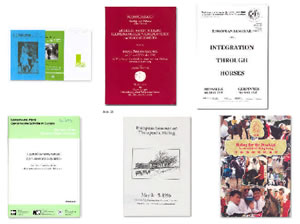
To finish up with a few special solutions, which had to be found.
There had always been a problem regarding full membership, where nations had two or more organizations with national importance, which demanded to be represented in the international council. The solution found was that many organizations would be able to become full members, as long as they could show evidence of their national importance, but that every nation would only have one vote, which meant all its national full members would have to work together, to reach an agreement. There had been initial problems with the constitution. It had to be decided whether the federation had authority over its members, or whether it was to be a forum for exchange of ideas, advice, development and information. The decision for a forum type function had already been reached in Milan.
The national organizations had to decide whether FRDI should, from the beginning, stick to an internal only constitution with by-laws and to become part of a larger international organization, e.g. disabled sport, to benefit from other funds, (e.g. from the sports industry). The decision was made for its own independent international organization, for which charitable status had to be achieved because of donations.
After a lot of research (inland revenue, German treasury, German UNESCO, Rotary International, European Union, Faculty of Law of Cologne University, Commission of the European Union) only Belgium was found to have legislation which allowed international charitable status.
It originates from 1919 and in 1954 was extended from only scientific associations to include philanthropic, religious and educational ones. It only requires the organization to be registered in Belgium and one member of the executive council to hold Belgian citizenship. From a legal point of view everything supports this solution and it has no drawbacks.
The financial position was secured through individuals being made associate members with all rights but without active voting rights for the FRDI. These are now able, for instance in Germany, to register their membership fee as a donation for tax purposes. This also applies to other donations made to FRDI.
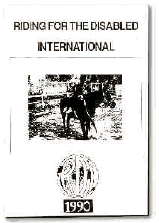
The appearance of publications shows that savings had to be made to enable advances to be made. (in the 50’s it was called ‘satisficing results’ = sacrificing for satisfying).
This also meant that the initial multilingual approach had to be stopped. English was the most suitable for the majority of members and organizations, to keep up communication, if these were then passed on by national associations in their own language.
As the death of Hubert Lallery caused the loss of the papers from I. International Congress so did the changes in the executive board cause a reduction in the knowledge of the diverse regulations and by-laws. It was agreed in Angers so republish them and to attach them to the constitution.
It leaves me with the need to express my thanks for the good team work, the engagement, personal efforts, the wealth of ideas, the ability to make decisions of the initiators, all of which made the development of the FRDI possible.